 | Holy Days
"We pray to those |
Mahavir Jayanti - March/April
This festival celebrates the day of Mahavira's birth.
Paryushana - August/September
The word 'Paryushana' means 'to stay in one place', which signifies a time of reflection and repentance for the Jain devotee. Originally this was primarily a monastic practice.
In Jainism it has special significance, as on this day in 527 BCE (according to Svetambara tradition) that Mahavira gave his last teachings and attained ultimate liberation.
Following Divali in October/November is an important festival called Kartak Purnima. This is considered to be an auspicious time for pilgrimage to the sacred sites associated with the Jain religion.
Mauna Agyaras
Around November/December time is Mauna Agyaras. This is a daylong observance of fasting and silence. Jains also meditate on the five great beings. | |
Saturday, June 6, 2009
HOLY DAYS


HISTORY
Jina or Jainism ?  |
"The Jain religion is one of the oldest religions in the world. The Jain religion was also known as Shraman Dharma, Nirgranth Dharma, etc. It is not an offshoot of any other religion but is an independent religion recognized by these various names during different time periods. It was has been taught by Tirthankaras also called Jina. A follower of a Jina is called a Jain and the religion followed by Jains is called Jainism."
|
Universal History of Jainism
No Founder: Jainism doesn't have a single founder. The truth has been revealed at different times by a tirthankara, which means a teacher who 'makes a ford' i.e. shows the way. Other religions call such a person a "prophet".
Trithankaras
A tirthankara appears in the world to teach the way to moksha, or liberation. A Tirthankar is not an incarnation of the God. He is an ordinary soul that is born as a human and attains the states of a Tirthankar as a result of intense practices of penance, equanimity and meditation. As such, the Tirthankar is not defined as an Avatar (god-incarnate) but is the ultimate pure developed state of the soul. Parshva: There is some historical evidence for the earthly existence of the 23rd tirthankara, Parshva, who lived about 250 years before Mahavira.
Mahavira: Mahavira is regarded as the man who gave Jainism its present-day form; although this is true only in the widest sense. He is sometimes wrongly called "the founder of Jainism".
Early Life of Mahavira
Mahavira was originally born as Vardhamana in north east India in 599 BCE (that's the traditional date but some modern scholars prefer 540 BCE, or even later).
Mahavira becomes an Ascetic
When Prince Vardhamana reached thirty years of age, not long after the death of both his parents, he left the royal palace to live the life of an ascetic, or a sadhana (one who renounces all worldly pleasures and comforts).
Mahavia the Teacher
From that day forward Mahavira taught the path he had discovered to other seekers. His teaching career lasted until his physical death in 527 BCE (according to Svetambara texts), when he was 72 years old. After a final period of intensive fasting he attained moksha, the final liberation from all rebirth. | |
JAINISM INTRODUCTION
Main Jain prayer:
Navakar MantraJain great vows:
Ahimsa · Asteya

Brahmacharya · Satya
Nirvana · Aparigraha
Anekantavada
Key concepts:
Kevala Jñāna · Cosmology
Samsara · Karma
Dharma · Mokṣa · Reincarnation
Swadhyay
Major figures:
The 24 Tirthankaras
Lord Rishabh to Mahavira
Acharyas · Ganadhars
Siddhasen Divakar · Haribhadra
Practices and attainment:
Four Stages of Enlightenment
Paramis · Meditation
Jainism by region:
India · Western
Sects of Jainism:
Svetambara · Digambara
Terapanthi · Early schools
Sthanakvasi · Bisapantha
Deravasi
Texts:
Kalpasutra
Agama (text) · Tattvartha Sutra
Sanmatti Prakaran
BASIC PRINCIPLES

>The principle Features are:
* Religion tolerance
* Ethical Purity
* Spiritual Contentment
Path to Liberation (moksha), which consists
of the three jewels (trinity or Ratna-Traya) of Jainism:
Right knowledge (Samyak Jnan)
Right Conduct (Samyak Charitrya)
Right Perception (Samyak Darsana)
Ratna-Traya of Jainism
Right knowledge (Samyak Jnan):
This means having an accurate and sufficient knowledge of the real universe - this requires a true knowledge of the five (or six) substances and nine truths of the universe - and having that knowledge with the right mental attitude.
One writer puts it like this: "if our character is flawed and our conscience is not clear, knowledge alone will not help us achieve composure and happiness".
Today this means having a proper knowledge of the Jain scriptures.
Some writers describe right knowledge as meaning having a pure soul; a soul that is free from attachment and desire...others say that a person who has right knowledge will naturally free themselves from attachment and desire, and so achieve peace of mind.
Right Conduct (Samyak Charitrya)
This means living your life according to Jain ethical rules, to avoid doing harm to living things and freeing yourself from attachment and other impure attitudes and thoughts.
Jains believe that a person who has right faith and right knowledge will be motivated and able to achieve right conduct.
Many Jains believe that a person without right faith and right knowledge cannot achieve right conduct - so it's no use following scripture and ritual for the wrong reasons (e.g. so that other people will think you are a good person). Not all Jains hold this view.
Right Perception (Samyak Darsana)
This doesn't mean believing what you're told, but means seeing (hearing, feeling, etc.) things properly, and avoiding preconceptions and superstitions that get in the way of seeing clearly.
Some books call samyak darshana "right perception". You can't achieve this unless you are determined to find the truth, and distinguish it from untruth.
overview of jainism

Religion & faith : Jainism
"Jainism is an ancient religion from India that teaches that the way to liberation and bliss is to live a life of harmlessness and renunciation. Jainism does not believe in God as the creator of Universe."
Overview of Jainism...
Jainism is one of the oldest religions of world. It believes in a universe without beginning, without end and without creator. Rishabhdev, the first Tirthankar, is mentioned in Rig Veda, the oldest scripture of Hinduism believed to be at least 5000 years old. The last of the 24 Tirthankars of this cycle of time was Lord Mahavira. Jainism became prominent religion in India at the time of Mahavira , who was born in about 599 B.C. in the town of Vyshali , (in the present day Bihar ) in a royal family
Around 80 A. D. the Jainism was divided into two sects. The Svetambara or "white clad" and The Digambara or "sky clad". The Svetambara are more liberal in their interpretation of Mahavirals teaching regarding nudity and allow their monks to wear a white garment. Women are also allowed in their religion and monasteries accepting the possibility that they may find salvation. The Digambara are more traditionalists. They adhere to the old ideals that require their monks to go about naked. The Digambara sect believes that women have no chance of achieving salvation until they are reborn as men.
Ahimsa (Non-violence) is the basic philosophy of Jainism. Anekantvad (Non-absolutism) Syadvad (Relativity of truth) and Karma theory form the basis of Jain philosophy. The scriptures of Jainism are Agana (precepts) or Siddhantas- (treatises). Jain code of conduct includes: Ahimsa (non violence), Satya (truthfulness), Asteya (non-stealing), Aparigraha (non-possessiveness), and Brahmacharya (chastity). These are very similar to the Buddhist code of conduct
WORSHIP
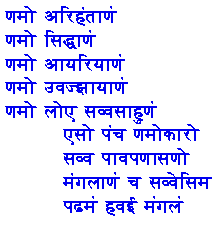

"Namo ariha.ntaaNaM
Namo siddhaaNaM
Namo aayariyaaNaM
Namo uvajjhaayaaNaM
Namo loe savvasaahuNaM
ma.ngalaaNaM cha savvesim
paDhamaM hava{ii} ma.ngalaM"
eso pa.ncha Namokaaro
savva paavapaNaasaNo
MEANING OF NAVKAR MANTRA
I bow to the Arahants, the perfected human beings, Godmen.
I bow to the Siddhas, liberated bodiless souls, God.
I bow to the Acharyas, the masters and heads of congregations.
I bow to the Upadhyayas, the spiritual teachers.
I bow to the spiritual practitioners in the universe, Sadhus.
This fivefold obeisance mantra,
Destroys all sins and obstacles,
And of all auspicious repetitions,
Is the first and foremost.
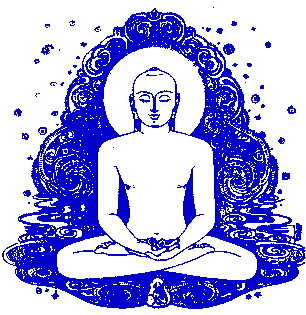
Jainism Worship
The motive and purpose of Jain worship is very different from worship in many other religions - in fact it would seem that Jain principles make worship both unnecessary and futile.
"What does it mean to worship beings that one believes are completely indifferent to, and entirely beyond the reach, of any form of Worship whatsoever?" Lawrence A Babb
Jains don't worship to please gods, or in the hope of getting something from gods in return. But nevertheless, Jains do worship.
At a superficial level Jain temple worship seems to contain elements similar to worship in Hindu temples. This is the result of the cultural influence of other Indian religions on the Jain community, and not a reflection of the Jain philosophy.
A key difference between Jain and Hindu worship, which seems similar on the surface, is that although Jains appear to worship the tirthankaras in particular they don't worship them as persons: what they worship is the ideal of perfection that the tirthankaras have achieved.
The Purpose of Jain Worship
Jain worship provides the individual with a discipline that helps them concentrate on the Jain ideals, and cultivate detachment.
The worshipper concentrates on the virtues of the tirthankaras and other pure souls, in order to help them follow their example.
So for Jains worship is only a means to an end and not a spiritual end in itself. And worship is not a sufficient means to that end.
"Some religions preach that an individual can be saved by devotion to God, the saviour, or to God's incarnations and intermediaries. Jainism teaches that we can attain true peace and happiness only through behaving and thinking rightly." Acharya Kundakunda